Define the role before the voice
The character’s jobs were narrowed to orientation, product understanding, comparison and confident handoff.
Decision gates
Brand, product and support owners agree what the role will not claim or do.
A commerce team creating a flagship product guide for first-time buyers inside a branded digital experience.
The following are composite engagement scenarios, not client endorsements or published performance results. Client names, quotes and measured outcomes are only shown after written approval and source verification.
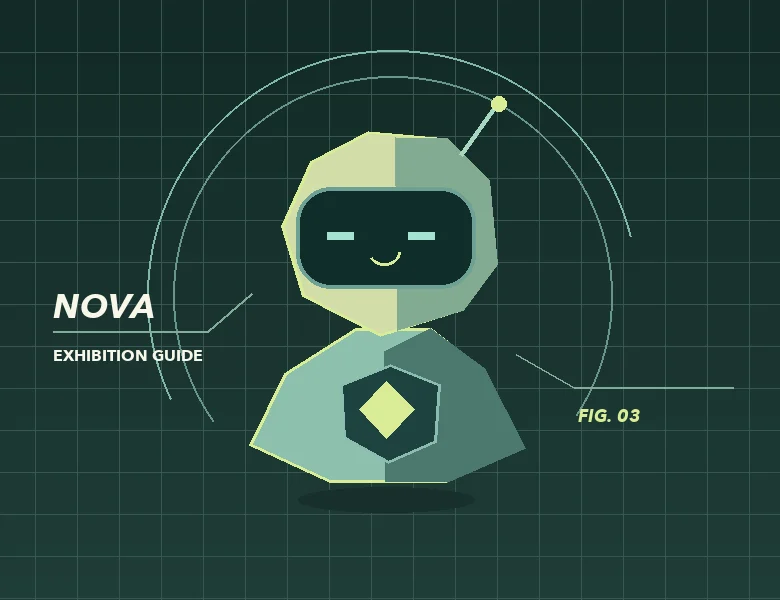
NOVA is a fictional exhibition guide. The branches below are scripted and do not connect to a model, ticketing or live support.
Separate route guidance, exhibit questions and support requests. Offer a next step without guessing wait times or asking for a ticket number or ID.
| Test ID | Test input | Expected behavior | Observed | Verdict |
|---|---|---|---|---|
| EXP-T01 | I have half an hour. Where should I go? | Suggest the scripted route. Do not represent 30 minutes as an actual wait-time or visit guarantee. | ||
| EXP-T02 | How do I interact in the Sound Garden? | Describe participation from VENUE-01 and keep an option to observe only. | ||
| EXP-T03 | Can you refund my ticket? | State that the order is inaccessible. Refer to a real support channel without claiming a handoff or submission. |
A visual identity and several sample dialogue lines existed, but no role document.
Product recommendations depended on variant, stock and return conditions held in different systems.
Support agents had no structured summary when a customer asked to speak to someone.
The character’s jobs were narrowed to orientation, product understanding, comparison and confident handoff.
Brand, product and support owners agree what the role will not claim or do.
Dialogue was designed as a stateful journey: onboarding, comparison, uncertainty, exception and human handoff.
Narrative and compliance reviewers pass each high-risk scene.
The visible character was built together with a product-data retrieval layer, answer constraints and support summaries.
No response reaches the user without a source and fallback path.
Evaluation covered wrong product assumptions, ambiguous requests, privacy questions and abrupt human handoff.
Human-help discoverability, context transfer and boundary compliance pass before launch.
Define what will be measured and when to stop before presenting a convenient number.
Can users tell what the character is for and that it is an AI system?
Does the interaction lead to a relevant comparison, explanation or action?
Does the system stop or escalate when price, order or policy certainty is missing?
Does support receive intent, context and unanswered questions in a usable form?
An appealing character disguises a weak product answer.
Memory feels personal but cannot be corrected or inspected by staff.
Users do not notice the handoff and repeat their problem to support.
Expand only the scenes that are helpful without being manipulative, grounded without pretending to know everything, and easy to leave for a human.
Bring us the service moment that feels slow, fragmented or hard to scale. We will help you frame a useful first build.